Showing posts with label Jesus' life. Show all posts

Monday, December 26, 2016

11 Ways Jesus Fought Patriarchy

Patriarchy is the system of a society which grants a male perspective, power and principles greater pull than women’s, even though both are equally human.  In the Jewish tradition Jesus grew up in, both equality between sexes and a male-centric view was available, but his society was focused on the male.  Only men were granted places of authority, only men were allowed to interpret law (which gave them control over politics and ethics), and men alone were allowed to conduct family business.

It must be admitted that Jesus upheld the patriarchy at points.  Only men were allowed to be in the inner 12, and he allowed men to buster and command as if they were really in charge of his community.  Nevertheless, there are a number of ways that we can see that Jesus was trying to undermine the male-centric society.

1.  Jesus took on female disciples
Jesus was running a religious/political school, and there were some rules about how these schools worked, one of which is that no female students allowed.  They would distract the men, and women wouldn’t be allowed to interpret the law or wield influence (If you aren’t sure on this, watch Yentl).  But Jesus welcomed female students.  There was a small group of women who “followed” him just like the male disciples.  And Jesus openly encouraged Mary, the sister of Martha, to participate in his teaching sessions, saying, “She has chosen the better part.”


2. Jesus defended women over men
While a teacher might approve of something a woman said, in a patriarchal society they wouldn’t support a woman over a man, because this would shame the man.  Jesus, however, publicly rebuked men when they were on the wrong side of an argument with a woman.  Jesus sided with the woman anointing him over his disciple, Jesus even sided with a prostitute over a high-standing politician in the politician’s own party.  In fact, we have no example of Jesus siding with a man over a woman. 


3. Jesus promoted "feminine" virtues over "male"
Most teachers of Jesus’ day upheld the principles of law and justice in judgment was the most essential principle.  Jesus, on the other hand, upheld the more “feminine” or relational, gentle virtues.  He told the Pharisees to learn this verse: “I desire mercy and not sacrifice.”  He spoke of love, humility and compassion as the principles which causes one to be right with God and to build a spiritual community on.


4. Jesus defended “non-feminine” roles for women
Jesus found himself in an argument between two sisters, Mary and Martha.  Martha insisted that her sister not be lazy, but to take on her proper role in the patriarchy, which was to serve the men.  Jesus took Mary’s side, claiming that her role of being a student is better than her traditional female role.  I’m sure Martha was fuming that she didn’t have help doing the dishes.  If Jesus had been on the ball, I’m sure he would have sent Judas to help her.


5. Jesus taught equality between husband and wife
In Genesis, there are two creation stories of the forming of men and women.  One supports men and women being equally created and unified in marriage.  The second promotes patriarchy, teaching that women were created from the “side portion” of men.  Jesus never mentions the second story, but quotes the whole passage of female equality in relation to a matter of divorce, in which women got the worst end.
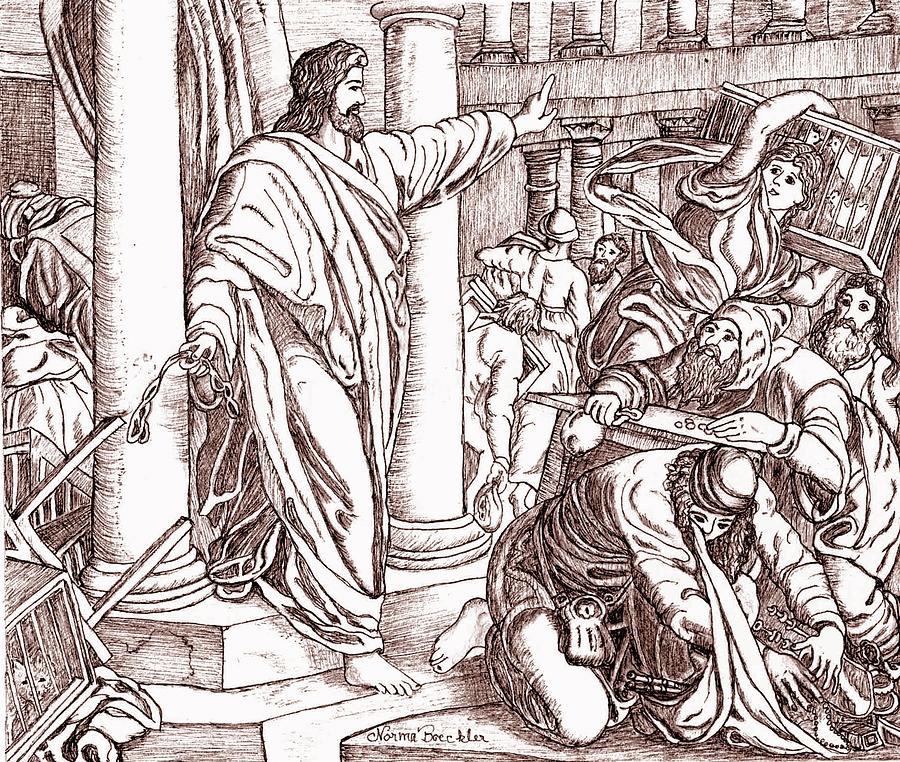

6. Jesus kicked the businessmen from the woman’s court
It was the policy of the high priest of Jesus’ day to allow people to exchange image-filled money with temple-approved money for sacrifices.  But Jerusalem was short on space, so the high priest allowed the money-changers to conduct their business in the “women’s court”, which was the only part of the temple women were allowed to worship and pray in.  Jesus threw the businessmen out, changing the high priest’s policy, reserving the space of women’s worship to be for them.


7. Jesus called himself a mother hen
In his sorrow over Jerusalem, Jesus proclaimed, “How I longed to gather you as a hen gathers her chicks.”  Not a great blow for feminine equality, but his heart is in the right place.


8. Jesus defended a woman caught in adultery
The famous story about Jesus and the woman caught in adultery is often placed in the book of John, but it doesn’t really belong there.  Some old manuscripts place the same story in Luke, but it doesn’t really belong there, either.  We don’t know where it goes, or if it’s really something Jesus did.  But we think it sound like something Jesus would do.  Why?  Because he defends a woman, who was “caught in adultery”, but the men who brought her didn’t bring the other culprit she was caught with.  Again, Jesus in this story promotes the female principle of forgiveness over punishment.
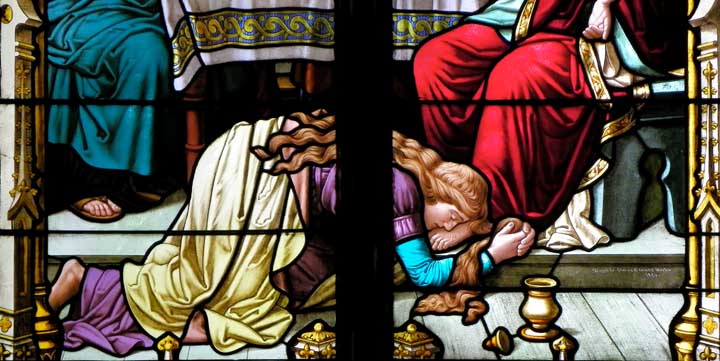

9. Jesus gave a woman primary place in his gospel
There is only one person whom Jesus guarantees a place in his story: the woman (some say Mary) who anointed his feet and who got yelled for it.  Jesus said, “Wherever the gospel,” (gospel =  good news of victory) “is taught, what this woman did will be told.”  This woman’s act is central to Jesus’ victory over the society of the world.  Partly because it was a woman who did it.  Without women, Jesus recognizes, his story would never be told.


10. Jesus recognized a woman’s gift over the wealthy
In looking at the givers to the Temple, Jesus recognized one person over the rest—a woman who had no standing in society, no way to make money because she had no husband to stand for her.  She gave a small coin, but because it was all she had to live on, Jesus proclaimed her gift the greatest.  (He did not, however, say it was just, as he rebuked those who collected the money as “devourers of widow’s homes.”)


11. Jesus’ first resurrection witness was a woman

The greatest thing for woman Jesus did was for Mary Magdalene.   She was the first--and for a while, only—witness of Jesus’ resurrection.  This was in a society in which woman couldn’t be a legal witness, where men didn’t have to believe women’s testimony.  But Mary was the one Jesus trusted to tell the story without twisting it.  No matter what, every man who told the story had to admit that a woman knew about Jesus’ resurrection before anyone else.  That she had to tell them, because they were in the dark.  This is a fitting beginning to a society built upon equity.

Too bad it fell from that lofty position so quickly and firmly. 


Wednesday, June 24, 2015

The Trials of Jesus

After all the time of Jesus claiming to be king of Jerusalem and of his work to show himself worthy as king, it is finally time.  Now he will be shown before the current leaders of Jerusalem.  If they decide they like what he says, he will be given more time to prove his case.  But if they reject him, he will be killed.  God has already determined that these hard-hearted, rebellious rulers will oppose God and kill his Son.  But if they do that, it will mean their end.

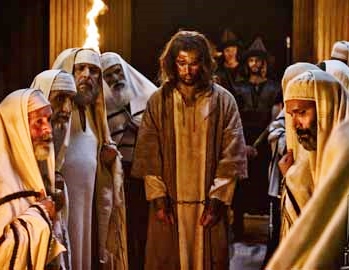
The Sanhedrin is the ruling council of the Judeans.  It is led by the High Priest, and all the significant laws and decisions about the Jewish nation is made here.  Jesus is taken to them at night, where many await to accuse him.  Some of them say, “We heard him say that he would destroy the temple!”  But the witnesses contradicted each other.  The High Priest went to Jesus and said, “Don’t you hear what these witnesses say against you?  Why don’t you answer?”  But Jesus remained silent. 

Finally, the High Priest, angry that Jesus would say nothing, demanded, “I command you by the Most High God—are you or are you not the Messiah, the Son of God?”  Jesus replied, “I am.  And you will see the Son of Man coming in the clouds at the right hand of power.”  The leader of all the Jews was infuriated that Jesus would claim to be beside God.  He tore his clothes in disgust and cried out, “Blasphemy!  He cannot claim to have God’s authority in heaven!  What do you say?”  And all of the Sanhedrin agreed that he should be put to death.  They released Jesus to the temple guards to be beaten and sent away.

Peter, meanwhile, was sitting outside the High Priest’s house, waiting for a verdict.  One of the girls recognized Peter and said, “Are you with that Galileean?”  Peter didn’t want to be caught, so he answered quickly, “No.”  Another said, “Surely you are—you can’t hide your Galillean accent.”  Peter replied, “No, I’m not.”  A soldier nearby said, “I think I saw you with him.”  Peter cursed and said, “I don’t know him!”  Then he heard a cock crow, and Peter realized that Jesus had predicted the denials Peter had just spoke.  And he ran away and wept.

The Sanhedrin could not kill Jesus legally without Roman agreement.  At that time, Judea was under the power of the Romans, who allowed the council to create laws, but demanded that a governor rule the province.  The most recent governor was Pilate, who was known to dislike Judeans, and not understand many of their customs.  The High Priest and others of the Sanhedrin brought Jesus before Pilate and accused, “This man has called himself a king and has been stirring up trouble in Jerusalem and Galilee.”  Pilate didn’t want to try him so he said, “Oh, is he from Galilee.  Fine, Herod is in town, and Galilee is Herod’s province.  Let Herod deal with him.”

They brought him to Herod, who had killed John the Baptist.  Herod had heard of Jesus and wanted to hear Jesus or to see him perform a miracle.  However, Jesus said nothing and did nothing before Herod.  Herod was enraged and sent Jesus back to Pilate to be killed.

The Sanhedrin accused Jesus of many evils before Pilate and the crowd that was forming.  Jesus said nothing.  Pilate looked at Jesus and asked, “So, are you a king?”  Jesus replied, “I have a kingdom, but it is not of this world.  If my kingdom was a worldly kingdom, my disciples would be fighting right now.  But it isn’t.”  Pilate said to the Sanhedrin and the crowd, “I find no guilt in him.”  The priests were encouraging the crowds to cry, “Crucify him!” 

Pilate said, “Look, I usually release one prisoner at Passover time.  I haven’t done that yet.  I have in my prison a man named Barabbas.  He is a rebel against the proper authorities and he has murdered a man.  Who would you rather me release, the murderer or this so-called ‘king’?”  The priests encouraged the crowd to cry out, “Barabbas!”  Pilate was shocked, but he released the murderer.

Then he decided to have Jesus whipped thirty nine times, so he could look weak.  Jesus was whipped bloody, and then brought out before the crowd.  Pilate cried, “Look at him!  See how pathetic he is!  He won’t harm anyone.  I am going to release him.”  The crowd shouted out, “Crucify him!  If you release this king, you are no friend of Caesar’s!  Crucify him!”  Pilate didn’t want any bad word to get to Caesar at this point, or his life could be at stake.  So he washed his hands and said, “I have nothing to do with this.  Take him away.”

And so Jesus was sent to be crucified.

Again the high priest was questioning Him, and saying to Him, "Are You the Christ, the Son of the Blessed One?" And Jesus said, "I am; and you shall see THE SON OF MAN SITTING AT THE RIGHT HAND OF POWER, and COMING WITH THE CLOUDS OF HEAVEN."  (Mark 14:61-62)


Jesus answered, "My kingdom is not of this world. If My kingdom were of this world, then My servants would be fighting so that I would not be handed over to the Jews; but as it is, My kingdom is not of this realm."  (John 19:36)

Tuesday, June 16, 2015

In The Garden

After Jesus’ last dinner with the twelve, Jesus led them to a Garden just outside Jerusalem.  He had a few more things he wanted to say to them, apart from Judas who betrayed him  “I am leaving you, and you can’t go with me now, but later you will go with me.”  One of disciples responded, “Lord, we don’t know where you are going, so how can we know the way?”  Jesus replied, “I am the way, the truth and the life.  No one comes to the Father except through me.  Don’t be sad that I am going.  I am going to the Father to prepare a place for you. 

“It is good for you that I am going, actually.  If I didn’t leave, then you couldn’t receive the Holy Spirit.  No mater how long I am gone, the Holy Spirit will be with you to remind you of all that I taught and to give you all the truth you need.  The Holy Spirit will convict the world of their sin and their need to come to the Father.  But through him I will be with you always.

“The most important thing for you to do is to love each other.  Everyone will know you are my disciple if you love each other.  The greatest love is this: that you love each other.  You must follow my commands—that is how you will show your love for me.  And the command I most want you to follow is to love one another.  If you obey my commands then you will know that the Father loves you.”

Then Jesus stopped and prayed, “Father, glorify your Son that he may glorify you.  I have glorified You on earth.  I have given these your word and have done all that you asked me.  Now glorify me so that I may have the glory that I had before, with You.  Watch over these whom you have given me, may none of them fall away.  Make them holy.  Also I ask for those who will believe later.  Make them one in You, Father.  May they be one as you and I are one.”

Then Jesus became sad, and said, “You eight stay here and rest.  Peter, James and John, follow me.”  Jesus walked with them to the other side of the garden and said, “My soul is grieved, even to the point of death.  Stay here.  Watch and pray.  I will be over there, praying.”  Jesus, alone,  then cried out to the Father and said, “Abba! All things are possible for you!  Please remove this cup from me!”  After some time, then Jesus cried again, “Father, please take away this cup.  But not my will, but yours be done.”

Jesus walked back to check on the three disciples, and he found them asleep.  “Why are you sleeping?  You will never be prepared for the trial you are to undergo like this!  The Spirit is willing, but the flesh is weak.  Stay awake and pray!”  Jesus went back to pray, and after a time, he came back and found the disciples sleeping again.  He left them and prayed more.  Then he returned and said, “Wake up!  It is time!  The betrayer is here, and the Son of Man will be handed over to sinners.”

Some soldiers came into the garden with Judas Iscariot.  Judas came up to Jesus and kissed him, saying, “Hello, Master.”  Jesus said, “So you will hand me over with a kiss?  How ironic.”  The kiss was the soldier’s signal, and they came and grabbed Jesus.  The disciples just woke them up, and were still groggy when they saw Jesus captured. 

Simon, remembering his words, grabbed his sword and started thrashing everyone around him.  He hit no one except the slave of the high priest, whose ear he cut off.  Jesus yelled, “That is enough!  Whoever lives by the sword will die by the sword.  And if I am not taken in this way, how will the Scriptures be fulfilled?”  Then Jesus picked the ear off of the ground and placed it back, healing the slave.

Then Jesus turned to the crowd arresting him and said, “I have been in the Temple every day, teaching.  But you are capturing me now, in secret with threat of violence.  Why are you treating me like a rebel against the proper authorities?  But all of this was done to fulfill the Scriptures.”  Confused as to what they should do, all of the disciples ran away.  And the soldiers and the crowd took Jesus to the High Priest’s house.

Keep watching and praying that you may not come into temptation; the spirit is willing, but the flesh is weak." Mark 14:38 

This is My commandment, that you love one another, just as I have loved you. Greater love has no one than this, that one lay down his life for his friends. You are My friends if you do what I command you.  John 15:12-14

Monday, April 13, 2015

The Last Supper

Jesus had prophesied his death and resurrection many times to his disciples.  The Father now told Jesus, it is time—this very night.  There would be no more prophecies, no more speculation.  It was time for action.  But the disciples were still not ready.  They didn’t understand what was coming or what it meant.  Jesus realized that it was too late to explain to them clearly what would happen that night.  All he could do for them this night is to teach them things they would understand later.

            Judas Iscariot, one of the twelve disciples, had had enough. He didn’t like Jesus speaking against the priesthood and the temple—they were the center of all good Jews believed in!  So he went to the priests to ask them what to do.  The priests responded, “We want to bring him to the Sanhedrin, but we wish to do so privately.  Lead us to where he stays at night, turn him over to us, and we will discipline him appropriately.”  They didn’t tell him that they planned to kill him.  Judas agreed to hand him over, if they would pay him silver. 

The Passover celebration was coming, and Jesus told his disciples to get ready for it.  He had his disciples obtain a guest room for them to eat in and they prepared for the meal.  But Jesus had his own plans for the meal.

            After Jesus entered into the prepared room, he took a cloth and tied it around him, and filled a bowl full of water so that he looked like a slave serving his master.  Then Jesus bent over one of the disciples already sitting back on a chair and began washing the disciple’s feet—the dirtiest part of him, after walking through the dirt and mud all day.  The disciple was repulsed by Jesus’ action—the Rabbi shouldn’t be doing slave’s work!— but the disciple didn’t say anything, because he couldn’t contradict his master.  Then Jesus went around, washing all the other disciple’s feet.

            When Jesus came up to Simon Peter, Peter boldly stated, “I will never let you wash my feet!”  Jesus gently replied, “But if you don’t let me wash your feet, you will have no part of me.”  Peter then changed his mind—“Then I want you to wash all of me!”  Jesus smiled and said, “You don’t need all that, Peter.  I’ve already washed you through my teaching.  For now, you only need your feet washed.”  Then Jesus washed Peter’s and the rest of the disciples’ feet.

            Jesus took off the cloth and sat in front of his disciples, the teacher once again.  He taught them, “Do you understand what I have done to you?  I am your teacher, yes, even your Lord.  But I have acted like a slave, serving you and making you welcome in this place.  Now if you are going to be my disciples, you must do what I do.  I want you to serve each other and welcoming to each other, just as I have been welcoming to you.”

            It was then time for the meal.  Jesus took the bread and prayed over it, giving thanks to the Lord.  Instead of just handing it around, he paused, waiting for all the disciples’ attention.  Then he slowly and deliberately broke the bread.  “This is my body which is broken for you.  Take it and eat.”  Jesus passed the bread around, and each of the disciples ate of it. 

            Then Jesus poured wine into a cup, and all the disciples were looking at him.  He said, “This is my blood.  It is the new covenant, the establishment of God’s kingdom.  Drink this.  And every time you drink this cup, drink it as a memorial for me.  For I will not drink wine again until I drink it with you after my Father’s kingdom has been established on earth.”

            Again Jesus looked at all the disciples sitting before him.  “I am going to be handed over to the authorities.  And one of you sitting here will do it.”  All of the disciples were fearing for themselves and they asked Jesus, “Am I the one?”  One of the disciples sitting next to him asked, “Who is it?”  And Jesus said, “It is the one who dips his bread with me into the dish.” 

            Simon Peter, however, was boasting.  “I know that it isn’t me.  I would never betray our Lord.  I would stay by him, no matter what.”  Jesus said quietly, “Peter, you don’t know what you’re talking about.  This night, before the rooster crows three times, you will have denied that you even knew me three times.”  Peter was stunned and proclaimed, “Never!  I would die for you.”  Jesus said, “Simon, Satan desires to have his way with you, to tear you apart.  But I have prayed for you that ultimately, your faith wouldn’t fail you.  So after he is done with you, come back to your brothers, here, and strengthen them.”

At that point, Judas Iscariot, dipped his bread into the common dish with Jesus.  Jesus looked at Judas and said, “Do it.  Get it over with.”  Judas understood that Jesus knew what he had planned, and he ran away.  The disciples thought Judas was going to pay for the room and meal, and still didn’t understand what was happening.
           
"You call Me Teacher and Lord; and you are right, for so I am. If I then, the Lord and the Teacher, washed your feet, you also ought to wash one another's feet. For I gave you an example that you also should do as I did to you. Truly, truly, I say to you, a slave is not greater than his master, nor is one who is sent greater than the one who sent him.”  John 13:13-16 

Sunday, April 12, 2015

Jesus' Final Lecture: The Last Days

The temple in Jerusalem in the early 30s AD was a magnificent structure.  Herod the Great planned it to be one of the great man-made wonders of the world and after 40 years hard work by thousands of laborers, it was just that.  There were many buildings, but the center building—the Temple itself—was an amazing structure with stones as large as the ones that built the pyramids.  Not only was it a beautiful building, but it also displayed the power and wealth of Judea.  It was once the jewel in Herod’s crown, and now it is the glory of the High Priest who, with the Jewish council called the Sanhedrin, led the second largest people spread throughout Rome—only the Romans had more authority.  And it was this very High Priest—ruler of the Jews throughout the world—who was plotting to have Jesus executed.

At the end of the fourth day in Jerusalem, Jesus was walking with his disciples through the various buildings of the Temple.  The disciples, blue-collar workers from Galilee, were stunned by the presence of the Temple and mentioned the magnificence and marvelous, huge stones.  Jesus replied, “You are noticing the stones, are you?  Not one of these stones will be left on each other.”

            That night, they stayed within Jerusalem, resting on the Mount of Olives.  Peter and his brother Andrew and James and his brother John were disturbed at the earlier saying, and they approached Jesus that evening, after the formal teaching time was finished.  They asked, “Lord, we are surprised at the destruction of God’s Holy Temple.  When will this take place?  Is it close to the coming kingdom?  When will you rule?”

            Jesus sat down and told them, “Be very careful—there are so many liars.  Many will claim to know much about the Messiah and claim that the end is coming here or there.  You will hear about this war or that war and think that perhaps it is the final war.  There will be many earthquakes and famines and various uprisings—but none of these are the end.  Instead of these misleading signals, just look for the signs I will tell you.

            “I am going to send you to the whole world to preach the gospel.  And many people in many nations will bring charges against you and try to kill you.  Many people will hate you.  Brother will rise up against brother and father against son.  You will stand before governors and kings.  But just be patient and stay with the gospel.  If you remain with the gospel until the end, then you will be saved.

            “You will know the end, because of the armies that will surround Jerusalem.  And when the powerful persecutor of God’s people is in the one place he should not be—even as Daniel said he would—then it is time to run to the hills.  Once this happens, leave everything you have, don’t go back!  Remember Lot’s wife!  She turned around and was destroyed by judgment.  Don’t be like Noah’s neighbors who were marrying and eating and drinking without any expectation of judgement and then were destroyed in a moment.  This is how it will be in Jerusalem when it is destroyed. 

            “In those days there will be a time of terrible tribulation for all of God’s people.  They will be chased by armies and tested severely.  Unless God would have shortened those days, perhaps not even the chosen ones would remain with God.  But for their sake, God has shortened the days of this tribulation.

            “Then, after that period of tribulation, the Gentiles will rule over Jerusalem.  No one knows for how long, not even I—only the Father knows how long.  They will trample the great city with armies.


           “After that time, the powers in the heavens will be set aside.  The authority of the sun will diminish and the power of the moon will be set aside.  The rule of heaven itself will be upset.  And then look for the Son of Man, coming in the clouds.  This will not be hidden—he will be like lighting flashing from one end of the sky to the other.  All the powerful angels will come down to earth with him, and he will send them out to gather his people from all over the world, and all over heaven.

            “Then the angels will gather all other people in the world—all of the Gentiles of all the earth.  They will stand before the coming King, ruling in Jerusalem.  And the King will have them divided into two parts, one to his right and one to his left.

            To those on his right, he will say, ‘Be happy!  You will enter into my kingdom and live there eternally!  For I was hungry in your presence, and you gave me food and water.  I was without clothing and you gave me clothing.  I was sick and in prison and you came to visit me and help me.  Come and enter my joy!’  They shall reply, ‘Lord, when did we do these things?’  The King will reply, ‘When you did it to these, my disciples—even the lowest of them, you did it to me.’

            “To those who refused to help the least of these disciples, they will be punished eternally with fire prepared for the devil and his angels.  But the righteous will gain the true life, eternally.”

“The King will answer and say to them, 'Truly I say to you, to the extent that you did it to one of these brothers of Mine, even the least of them, you did it to Me.' “Matthew 25:40

Monday, September 22, 2014

Debating with Jesus, part 2

Jesus made quite an impact in the first couple days he was in Jerusalem.  He came into the town as a victorious king, and then he declared the legal practice of selling in the Temple to be illegal in God’s eyes.  He fully represented the authority of God in that place.  But those who actually ruled the Jews in Jerusalem—the members of the Sanhedrin and the ruling priests—were upset and wanted to challenge his authority.

On Jesus’ third day in Jerusalem, he was teaching in the Temple area, which is where the ruling priests and elders found him.  Immediately, they challenged him, “Who do you think you are?  On what basis did you think that you could act like a king?  Who is your authority?”

            Jesus replied, “If you want me to answer your question, you need to answer mine: Where did John the Baptist’s authority come from—God or from someone on earth?”  
   The priests and elders huddled together, discussing quietly a proper answer.  They said among themselves, “If we say his authority was from heaven, then this teacher will rebuke us for not listening to him.  If we say that his authority was not from heaven, the people will be angry at us.”  So they turned to Jesus and said, “We don’t know.”  
   Jesus replied, “Even so, I won’t tell you who my authority is.”

            Jesus then spoke to the crowds listening to his teaching, “There once was a farm and the owner put the farm under the control of some shareholders.  The owner sent a messenger to the shareholders, wanting some fruit of the harvest.  The shareholders, however, just beat the messenger and sent him away.  The owner sent many other messengers, but the shareholders beat them all and killed some.  Finally, the angry owner said, ‘I will send my son to them, for they will respect him.’  When the shareholders saw the owner’s son, however, they said, ‘Here is the owner’s son.  We will kill him and then gain the farm for ourselves.’  So they grabbed the owner’s son, beat him, threw him out of the farm and killed him.  When the owner heard this, he gathered his army and destroyed the shareholders and gave the farm to someone else.”

            Jesus then said to the chief priests and elders, “The Scripture says, ‘The building stone which the builders rejected has now become the chief cornerstone.’  Everyone who rejects this stone will be crushed by it.”  They knew that Jesus was speaking specifically against them, and they wanted to see how they could make him be ashamed in front of the crowds.

            So they sent a group of Sadduceean scholars to confront him.  The Sadducees didn’t believe that there would be any resurrection, nor did they believe in any Scriptures except the first five books of Moses.  They came to Jesus and said, “Good teacher, we have a situation we would like you to judge.  As you know, the law says that a woman whose husband has died must marry his brother.  A woman among us has become a widow, and so married her husband’s brother.  Suddenly, her second husband died, so she married another brother.  Then her third husband died, so she married another, and so on until she had married all seven brothers.  Finally, she died.  Our question is this: which man will be her husband in the resurrection?”


           Jesus replied, “You do not know the Scripture or the power of God.  When the resurrection comes, there will be no more marriage, but everyone will be like the angels of heaven.  As for whether the resurrection is true or not, didn’t God say to Moses, “I am the God of Abraham, Isaac and Jacob”?  God is not the God of the dead, but of the living—so there must be a resurrection.”  The Sadducees left, furious, but unable to answer him.

            Hearing his responses, a scribe came up to Jesus and asked, “Rabbi, what is the greatest command of the law?”  
  Jesus replied, “The greatest command is this: ‘Love the Lord your God with all of your heart, with all of your mind and with all of your strength.’  The second is like it: ‘Love your neighbor as yourself.’  All the law and the prophets rely on these two commands.”  After hearing his responses, no one asked him any more questions.

            Then Jesus said to his challengers, “Now I have a question for you:  David said about the coming king, ‘The Lord said to my lord, “I will set your enemies at your feet.”’  But if David is the coming king’s father, how can he call him ‘lord’?  But if he is not the king’s father, why do we all say that the coming king is David’s son?”  No one could answer him, and Jesus left Jerusalem for the day.

Sunday, January 26, 2014

Debating Jesus, Part 1

Jesus went out of Jerusalem that night to sleep.  The next day, he was back in the temple, teaching.  Some Pharisees came up the next day to challenge Jesus.  They flattered him, trying to make him give a foolish response to their question.  

They said, “Master, we know that you teach the truth and that everything you say is right.  So please tell us, should we pay taxes to the Romans?”  They knew that if Jesus said “no” then the Romans would arrest him, but if he said “yes” that he wouldn’t be popular with the people.

Jesus didn’t respond how they thought, however.  He said, “Why are you trying to trick me?  Do you have a Roman coin?”  One of the Pharisees pulled out a Roman coin and showed it to Jesus.  Jesus then asked them, “What image is on that coin?”  

Some of the Pharisees backed away, because they realized that Jesus was displaying to all the people that they had brought an image into the temple, which was immoral and illegal. One of the Pharisees responded, though, “That is Caesar’s image.”  

Jesus said, “All right then, since the emperor’s image is on the coin, if he wants it, give it to him.  It belongs to him, as you can see.  On the other hand, God’s image is on every one of you.  So give to God what belongs to Him.”

"Caesar Augustus/Son of God"

Sunday, August 4, 2013

Did Jesus Declare that He was the Messiah?

"Blessed are the cheesemakers?"
Scholars have debated whether Jesus actually declared himself as Messiah or not.  The words of Jesus are difficult, or vague or declared by scholars to be inadequate proof.

And why shouldn't they be questioning this fact?  John reports that the crowds who listened to Jesus were confused as to what he was saying.  There were debates both about what he was saying and about his qualifications to be the Messiah.

Jesus talked much about "the Son of Man", but that title could mean many things and it wasn't completely clear that he was speaking about himself.

Peter called Jesus "the Messiah", which Jesus didn't directly affirm in the book of Mark, and told the disciples not to speak about this.

Demons openly proclaimed him "the son of God" a messianic title, but Jesus told them to shut up.

Jesus accepted titles that declared his Lordship, like "Son of David" or "the Son of God" but he never affirmed them.  Was he just being polite?

All of this is quite confusing, really.  And many other indications, from a critical standpoint aren't absolute, such as later declarations by disciples or claims of fulfilled prophecies which could be interpreted many ways.

I think that the problem is that such scholars limit their scope to what Jesus said and aren't looking at what he did.  Jesus purposefully made his speech confusing, so that it might only be understood in combination with his actions.  What did his actions say?  There are four items that, from a scholarly standpoint, seem affirmed about Jesus' life.

1. Jesus healed
John the Baptist asked Jesus through messengers whether he was the "one" they waited for or not.  Jesus only demonstrated who he was, he didn't speak it.  "They blind can see, the deaf hear, the lame walk, the lepers are cleansed and the poor have the gospel preached to them."  These are actions that should happen at the center of God's kingdom, the temple.  Instead, Jesus himself was acting like a mobile temple, leaving healing and salvation in his wake.  This is again vague, but to heal is to claim to have the center of God's power on earth, to be the center of God's kingdom.

2. Jesus entered Jerusalem on a colt
This action wasn't just some strange ritual but was a clear declaration of Jesus' intentions that the leaders and people of Jerusalem clearly understood.  They knew that to enter Jerusalem on a colt with a number of disciples declaring his victory was a clear reference to Zechariah 9-- "Rejoice greatly, O daughter of Zion! Shout in triumph, O daughter of Jerusalem! Behold, your king is coming to you; He is just and endowed with salvation, Humble, and mounted on a donkey, Even on a colt, the foal of a donkey."  This does not mean that the inhabitants of Jerusalem believed in Jesus because of this fulfillment.  Rather, they would see this Galilean woodworker as an upstart.  However, this action clearly speaks to Jesus' intention-- that he is the king of Jerusalem, the Messiah.

3. Jesus cleansed the Temple
In the first century there were multiple, even contrary, ideas of what the Messiah was.  The term means "anointed one" and there were three offices in ancient Israel in which one could be anointed: King, prophet or priest.  Some declared that the Messiah already arrived in the person of the High Priest, who, for all purposes, acted like a king over the Jewish people.  The real target of Jesus wasn't Herod or the Romans, but the High Priest and his power base-- the Sanhedrin and their representatives through the synagogue system. It was this well-organized, structured theocracy that Rome feared.
          When Jesus entered Jerusalem the day after his colt declaration, he re-ordered the Temple according to love.  The High Priest had approved of money exchange agents to set up their tables within the temple, in the only place where women and Gentiles could worship YHWH.  Jesus got rid of them, making room for true worship.  In changing the High Priest's policy, Jesus was declaring himself the replacement High Priest, the one who can order the temple.  Thus Jesus declared himself the anointed King of Jerusalem and the anointed Priest of Jerusalem.

4. Jesus was crucified
You couldn't just steal something in the Roman empire and get crucified.  When modern translations declare some of those crucified to be "thieves", they give a wrong impression.  You had to be a non-citizen in open rebellion against Rome to be crucified.  These "thieves" weren't just robbers, but they saw themselves as Robin Hood-- bandits in opposition to an oppressive government, targeting wealthy Romans, or Roman supporters.
       For Jesus to be crucified, it means that he was seen to be a rebel against Rome.  None of his actions would seem to be worthy of that.  Teaching, healing, discussing interpretation of the law, even rebuking priests and elders are nothing to be crucified over.  But to declare oneself a king in direct opposition to Caesar's rule is certainly a rebellious act.
      If Jesus' act of entering Jerusalem on a colt is seen as declaring messiahship, if Jesus did make a statement about coming in the clouds of heaven to the Sanhedrin, if he claimed to replace the high priest though his actions in the temple, then there is enough evidence for him to be declared a rebel, and to be crucified.   Certainly it is evidence that Jesus' enemies felt they could say he was declaring himself to be Caesar's replacement.

Once scholars accept these four actions as declarations of messiahship, the rest of the story of the gospels falls into place and all the details make sense, not just as a story but as history.

The Silent Declaration of Jesus

When God announced to Jesus that Jesus was to be the Messiah, the king of Jerusalem, the only ones who heard this announcement was Jesus, John and the spirit world.  No other human knew of God’s announcement, and Jesus did all he could to keep it secret.  Finally, Peter figured it out, and Jesus told them his plans to take over Jerusalem: He would be rejected by the priests, killed and then risen from the dead.  The disciples never understood this part, but they were interested in letting people know that Jesus was the king.  Finally, they got their opportunity at the beginning of Passover week—a Jewish festival.  At the beginning of the last week of Jesus’ earthly life, the Jesus began to give Jerusalem hints at God’s call for him.

In ancient societies, if a king or emperor went out to war, and then came back to his city victorious, those in the city would spread their coats in front of him and palm branches, giving him honor as he came into the city.  In the prophecies of the Jewish Scriptures, it says that when the Messiah comes to Jerusalem, that he would come on a colt, and everyone would be proclaiming, “Blessed is he who comes in the name of the Lord.”

While staying at Lazarus, Mary and Martha’s house one morning, Jesus approached his disciples and said, “Today we are going to enter Jerusalem.”  He turned to two disciples specifically and said, “In the next village we pass by, you will see a young donkey tied up.  Take that donkey, and there will be someone who asks you what you are doing.  Tell him, ‘The Lord has need of it,’ and he will let you take it.”  The disciples did as he said, and someone did approach them and he did let them take the donkey after they had said what Jesus told them to.

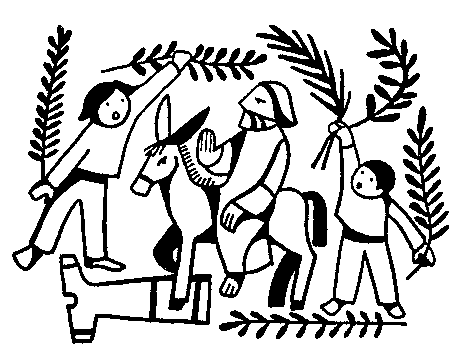
            Just outside of Jerusalem, the large group of Jesus’ disciples gathered around him.  Many of them placed their coats on the donkey, and Jesus sat upon the donkey, showing his authority over his disciples.  Then he rode the colt into Jerusalem, and the disciples placed coats and palm leaves onto the road in front of him.  All the while, the disciples were shouting out, “Blessed is he who comes in the name of the Lord,” and “Hosanna in the highest!”


           Some of the Pharisees saw all this, and felt that Jesus’ disciples were claiming too much for him. They came to Jesus and told him, “Teacher, rebuke your disciples!”  Jesus turned to them and said, “If these disciples remained silent, the rocks would cry out instead of them.”

            After the victory parade, Jesus and his disciples went directly to the temple area.  Jesus looked closely at all that was happening in the temple—some were offering sacrifices, some were praying, and in the outer court (where the Gentiles and women could worship) some were buying and selling animals for sacrifices and exchanging Roman money for temple money, so visitors could buy the sacrifices.  After looking at all this, Jesus said nothing, but went back to Bethany that night.

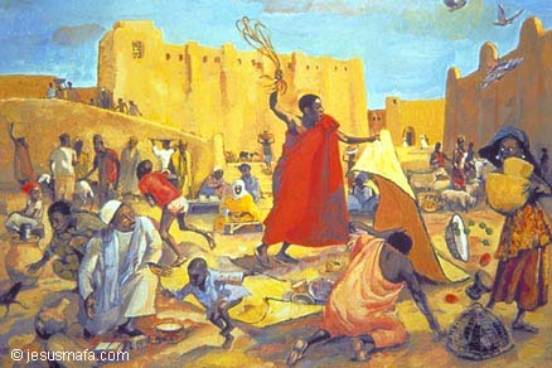
            The next day, Jesus and his disciples returned back to Jerusalem.  Jesus went immediately to the temple, and began knocking down the tables in the outer court, where people were exchanging money. Then he gathered some cords of rope and started whipping the places where people were selling animals for sacrifice.  He shouted out, “This is my Father’s house—a place of prayer for the nations!  But you have made it a gathering place for rebels!”  Many people in Jerusalem saw this and were pleased, and they listened to his teaching.

            This action angered many people.  The ruling priests were upset because they arranged for the selling to go on in the temple court.  Others were upset at the implication that Jesus had the right to enter Jerusalem as a victorious king and then to make decisions about how the temple was ruled.  “Who does he think he is?” they said.

Monday, July 29, 2013

Raising the Dead

The way the people in Jesus’ day understood healings is different from today.  Today, we see an illness as caused by germs or a problem in the body, and if you fix the body, the sickness goes away.  In ancient times, illness was caused by spirits and these spirits attacked the person, causing them to be sick.  Thus, when Jesus healed people, most of the time, people just saw him as getting rid of the spirit that was attacking them, which is why Jesus could command fevers and illnesses to be gone.

            But death was something else.  Again, today we see death as being a person’s body being unfunctional enough that it just stops and no one is able to revive it.  In ancient times, however, death is seen as a person being put under the control of one of the most powerful spirits of all—Sheol, or the power of Death.  And when one is handed over to Death, there is no human who could bring that person back.  Death is a kind of slavery—a person is being handed over to such a powerful Master that no one could call them back.  No one, until Jesus.

* * *

            Jesus and his disciples were travelling through a town called Nain.  In the city, near the gate, there was a funeral.  A widow was mourning the departure of her only son.  Having no men left in her family, the widow was now destitute, with no where to go.  Jesus saw this, and told her, “Do not weep.”  The people around thought he was crazy.  Then Jesus placed his hand upon the cot on which the body was carried and said, “Young man, get up!”  Immediately, the man sat up and began to speak.  All the people were stunned and said, “God has come to visit us!”

            As Jesus was heading toward Jerusalem, he got word that his good friend, Lazarus, was terribly sick.  Lazarus was the brother of Mary and Martha and they all lived in Bethany, an easy walk from Jerusalem.  
The messenger who told Jesus the news added, “Please come, Lord.”  
Jesus replied, “This sickness will not end in death, but God will be glorified through it.”  Even so, Jesus did not go to Lazarus, but remained where he was, ministering to people. 


           Two days later, Jesus said, “Come, let us go to Jerusalem.” 
His disciples said, “The people in Judea will want to kill you, Lord. Perhaps now isn’t the time.”  
Jesus replied, “My friend Lazarus is asleep, and I must go to wake him.”  
One of the disciples said to Jesus, “But if he’s asleep, Lord, then he might get better.  You shouldn’t wake him!”  
Jesus replied, “You don’t understand.  Lazarus is dead.  But I am glad he died, so that you might see God’s works and so believe. Let’s go to Bethany.”  
Another disciple, mourning Lazarus, said, “Yes, let’s go, so we can die with him.”

            Many from Jerusalem were there mourning with Mary and Martha, when Jesus arrived, for Lazarus had been in the tomb four days by the time Jesus arrived.  
Martha came out to meet Jesus and said, “Lord, if you had been here my brother wouldn’t have died.” 
Jesus said, “Your brother will rise from the dead.”  
Martha replied, “Yes, I know, Lord.  On the final day, we will all rise.”  
Jesus said, “Do you believe that I am the resurrection right now?  That whoever is faithful in me will rise again, even though he dies? That whoever believes in me will never die?”  
Martha said, “Yes, Lord.  You are the Son of God.” 

            Martha then got her sister Mary and said, “The Teacher wishes to see you.”  
Mary went to Jesus and also said, “If you had been here my brother wouldn’t have died.”  
Jesus saw her crying deeply and all those from Jerusalem were also weeping.  He saw their love for Lazarus and their unbelief and he also wept.  
Those from Jerusalem said, “See how much he loved Lazarus!”  And some also asked, “Jesus is such a powerful healer—if only he had come here soon enough so that Lazarus wouldn’t have died.”

            Jesus asked Mary, “Where is the tomb?”  
So Mary led him to the tomb where Lazarus was.  It was a cave with a stone in front of the entrance.  
Jesus said, “Roll back the stone.”  
Martha complained, “But Lord, the stench would be awful!”  
Jesus replied, “Didn’t I tell you that you would see God’s glory?  Do as I say!.”  So the stone was rolled back.  Then Jesus prayed “Father thank you for hearing me.”  Then he shouted to the tomb, “Lazarus, come out!”  
And Lazarus, wrapped in linen, walked out of the tomb. 
Jesus said, “Unwrap him and let him go.” 

            Many believed in Jesus that day, and word spread throughout the area what Jesus did.  Even the high priest heard of this miracle and was stunned.  But instead of believing in Jesus, he saw Jesus as a powerful rival—one that must be done away with.

Sunday, December 30, 2012

Jesus and the Rich


Jesus was determined to go to Jerusalem.  He was going there to proclaim his authority over the city, but also to be killed by the leaders.  Nevertheless, he made it clear that he was heading toward Jerusalem.  Some of the Samaritans, who thought the temple in Jerusalem was not of God, was angry at Jesus because of his focus on the city, but Jesus ignored them.  Every step drew him closer to the cross, and he called everyone who followed him to take up a cross for themselves.

As Jesus was walking to Jerusalem, a young man stopped him and asked a question, “Good Teacher, what do I have to do to gain eternal life—to enter God’s kingdom?”  It seemed at first that the man was just trying to test Jesus so Jesus said, “Don’t flatter me.  Only God is ‘good.’  And as far as your question goes, everyone knows how to have eternal life, you don’t need to ask me about that.  Follow the commands from God—Don’t commit adultery, don’t bear false witness, honor your father and mother—you know all that.”

            The young man replied, “Yes, I know all that.  I have been keeping these commands all of my life.  Are you telling me that there isn’t anything more?”  Jesus then saw that the man was sincere and he desired to help him in any way he could, “If you want to be sure of God’s kingdom, then do this—sell off everything you have, then take that money and give it all to the poor.  At that point, your reward in heaven is guaranteed.  Once you’ve done that, follow me.  I am going to the cross, and anyone who would come after me must deny themselves, take up their cross and follow me.  Come.” 

            However, the young man walked away in mourning because he had many possessions and to get rid of them all was very difficult.  He didn’t know he could do it.  Watching the man, Jesus mentioned to his disciples, “It is very hard for a rich man to enter into God’s kingdom.”  The disciples were surprised at this, so Jesus said, “Are you surprised?  It is so hard for a rich man to enter into God’s kingdom, that it would be easier for me to take a camel and put it through a needle’s eye than to get a rich man into God’s kingdom.”  The disciples were shocked and said, “Then can no one be saved?  Can no one enter into God’s kingdom?”  Jesus nodded and said, “It is just about impossible.  But the things that are impossible for people are more than possible if God is with you.” 

Peter's boat, still at the Sea of Galilee
            Peter, though, thought about what Jesus said to the wealthy man and asked, “Lord?  You told that man to sell his possessions and give to the poor.  But we didn’t sell our possessions.  We left them, yes, but they are still sitting there waiting for us.  And I had no intention of selling them.  Will we gain God’s kingdom?”

            Jesus replied, “Don’t worry, Peter.  Anyone who gives up what they have for me and for the gospel—whether it be their family, their homes, their land or their job—will gain more, much more.  Those who surrender all for me will gain more family, more homes, more land and more work—and more persecutions.  And in the end, they will gain eternal life.”

            A little while later, Jesus was travelling through Jericho on his way to Jerusalem.  As he was passing through, a huge crowd surrounded him, blocking the streets.  There was a very wealthy man in Jericho named Zaccheus.  He was a chief tax collector of the Romans, and that and his wealth indicated that he had cheated money out of his fellow Jews.  Because of this, he was ostracized by all of his people, they wouldn’t even go to his house or greet him. 

            Zaccheus, however, greatly desired to be right with God.  And he figured that Jesus was one of the last chances he had to repent and make peace with God.  So Zaccheus tried to get through the crowd to meet Jesus.  But he was so short, no one even noticed he was trying to get through.  Frustrated, Zaccheus decided that even if he had to look foolish, he would meet Jesus.  So Zaccheus went ahead of the crowd and climbed a tree, and then waited for Jesus to pass it. 

            As the crowd passed, they laughed at him, but Zaccheus didn’t care.  One of those from Jericho whispered to Jesus, “This is Zaccheus, the chief tax collector of Jericho.”  That was all Jesus needed to know.  He said, “Come down Zaccheus.  I need to stay at your house today.”  Zaccheus thought that was great—he was finally having the change to make his life right with God.  But some others didn’t think it was great.  They said, “Doesn’t he know what a terrible sinner this man is?  Why is he even talking to him?”

            Zaccheus heard the accusation and said, “I say that beginning today I will give half of what I make to the poor.  And on top of that, I will do just as Moses’ law commands and give back four times as much to anyone whom I have stolen from.”  Jesus was impressed and said, “You see—today Zaccheus has come back from sin and is once again a child of Abraham.  For the Son of Man came to seek and save that which was lost.”