Wednesday, November 7, 2012

Jesus and Gentiles


The majority of Jewish people, who worshiped God and honored the Scriptures, did not associate with anyone who was not Jewish.  The non-Jewish people—those who were not born in a Jewish household—were called “Gentiles” and they were rejected as apart from God and apart from the people of God.  For the most part, this was true.  Most Gentiles worshiped idols and practiced evil, and enjoyed evil.  And so the Jewish people wanted to have nothing to do with these types.  The Jewish Sanhedrin even established laws to separate themselves from Gentiles.  There was a law that said that they may not enter into a Gentile’s house or eat with one.  Many felt that a law should be passed that did not allow Jewish people to eat meat in Gentile cities for fear that the meat might have been offered as a sacrifice to an idol.  Jews and Gentiles never had anything to do with each other, if they could help it. 

However, there were some Gentiles who believed in God and wanted to worship him alone.  They were called “proselytes” and while they could never enter the temple, it is possible that their children might be able to.  Jesus had a mixed reaction to Gentiles, but he affirmed one thing—that anyone, whether Jew or Gentile, sinner or righteous person—anyone can come to God if they have faith.  And that those who do not have faith cannot come to God, even if they were the best Jew in the world.

Jesus was walking near Capernum one day when a Roman Centurion came up to him, looking for help.  “I have an important servant,” he said, “who is very ill.  Would you please heal him?”  Some Jewish men were with the centurion and witnessed that he was a righteous proselyte who paid for their synagogue to be built.  Jesus said, “Very well, let’s go to your home.”
            The Centurion stopped him however and said, “Please don’t.  I am not worthy for you to enter my home—I don’t want you to be defiled by entering it.  Look, I am a military man, and I am used to taking orders.  Everyone in my household does as they are told.  I say, ‘Do this’ and they do it.  There is no need for you to come with me.  Just speak the word, and my servant will be healed.”
            Jesus was amazed at this response.  “I have never heard a Jew show so much faith!  I tell you the truth, on the final day, there will be many people who come from far away—far from the east or far from the west—and they will sit with the Jewish fathers, Abraham, Isaac and Jacob.  But there will be many who are Jewish, who live in Jerusalem, who will be thrown out of the Jewish kingdom of God.”
            Then Jesus turned to the Centurion and said, “It will be as you say.  Your servant is healed.”  The Centurion went back home and found that his servant was cured in the same hour Jesus spoke the healing.
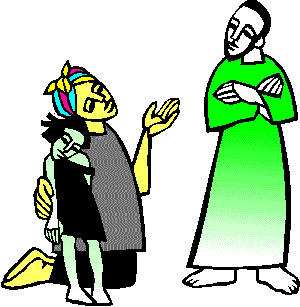
           At one point Jesus traveled to Tyre, a Gentile city north of Israel with a large Jewish population.  Jesus was sitting at a table with some Jewish people, telling them about the kingdom of God and eating.  A Canaanite woman was sitting below Jesus on the floor, near the disciples.  A Canaanite was someone, according to the Bible, cursed by God, never allowed to approach God or ask him for help.  But she kept asking Jesus for help, to heal her daughter who was possessed by a demon.  Jesus kept teaching, just ignoring her.  Some of the disciples near the woman was offended by her and asked Jesus, “Could you please get rid of her?  She’s bothering us, and we can’t hear your teaching.”
            Jesus then turned to her and said, “Go away, dog.  It is not allowed to take the food of the children and throw it to dogs.”  Jewish people often called Gentiles “dogs” to show how offended they are by them.  But the woman said, “But aren’t even the dogs allowed to eat crumbs that fall off of the children’s table?  I don’t care what you call me, heal my daughter.”  Jesus was amazed.  “Your faith is great!  You are humble enough to accept an insult and still ask for God’s help?  Go home, daughter.  Your daughter is healed.”

            As Jesus was nearing Jerusalem, he knew that his end was near.  He was teaching, and then his disciple Philip came up to him and said, “Jesus?  There’s some Gentiles here who would like to speak to you.”  At once, Jesus began speaking to the crowd, “It is time for my lifting up.  Now it is time for God to glorify me.  If a grain of wheat wishes to become many, he must first die and be buried in the ground, and then it will multiply.  Even so, if any of you wishes to save his life, you must lose it.”

Thursday, November 1, 2012

Experiencing Jesus

Atheists fascinate me.  I just don't get them.  From their experience and perception of the universe, they determine that God cannot possibly exist.  I don't deny them their claim, but I do find it an amazing act of faith.  Because they are denying the existence of a person because they have not experienced that person.  If I say to you, "The other day my friend Bill said to me..." and you interrupt me and say, "I'm sorry, but I've never met Bill, so I don't believe he exists" I think I might be justified in wondering at your reasoning.  You don't have to have met Bill to know that I have experienced Bill in some way.  Even so, there are billions of people who have experienced God in some way, and while you don't have to act on the experience of others, is it really rational to simply deny the experiences of the majority of humanity?

However, the basis of any relationship is experience.  To consider someone "saved" because they are convinced by an intellectual argument or because they rationally believe in a doctrine seems a considerable distance from Jesus' statement, "Trust in God, trust also in me."  Trust means knowing a person, finding them to be reliable and so leaning on them.  While part of our experience of Jesus is intellectual, that cannot be the heart of it.

But each person's experience is different.  Jesus only took three disciples out of thousands to the top of the mountain where they saw him transfigured in glory.  The majority heard this story, eventually, but only a bare few had this experience.  It is interesting that Jesus repeated this experience for his persecutor, Saul of Tarsus, but again, the 3000 who believed in Peter's message didn't have this experience.

Many more were directly healed by Jesus.  We don't have any numbers, but it was enough that thousands more followed Jesus wherever he would go to possibly be healed.  These healings continue to this very day.  There are many thousands who live today who affirm that their healing, their deliverance, their sound mind can be given to the glory of Jesus.  This is a powerful experience.  It means that Jesus is not only kind and merciful, but also powerful enough to change our lives for the better.

Still more have experienced Jesus through the actions of others.  There are so many who follow Jesus example, obeying his commands to love, show mercy, be compassionate, to give to the poor, to forgive.  And this community of love is experienced by millions of people throughout the world.  This is Jesus in his people, alive, powerful and changing the world one act of kindness at a time.

If we see our experience of Jesus as something intellectual, then we will base our life in Jesus as arguments, convincing others that we are right and they are wrong.  But the heart of Jesus is relationship: love, mercy and forgiveness from Him and from His people.  To whittle Jesus down to the intellect is to make him far too small: a weak and petty thing.

Friday, October 5, 2012

Jesus Revealed


Jesus had just revealed to his disciples his most important secret—that he was the coming king that had been promised, but that he would be killed before the end.  At this point the disciples might doubt that he really is the king.  But he gave them convincing proofs that he really was the king, the coming Messiah.   Jesus had said to the disciples and the crowd, “There are some of you standing here that will not die before you see the kingdom coming with power.”  This excited people, because they thought he meant that the end would come before the end of their lifetimes.  But Jesus meant something different than what they thought.

            Six days after Jesus declared to the disciples his plan to conquer by death, he told his three closest disciples—Simon Peter, James and John—to follow him while the rest stay behind.  The three followed him up a steep hill, where there was no one else.  The three looked around, and they saw Moses and Elijah there, waiting for Jesus.  They looked at Jesus and saw that his whole appearance had changed—he was shining and his clothes were brilliant, whiter than anyone could clean it.  They realized that they weren’t seeing Jesus on earth, but Jesus as he really is in heaven.

            The three were so stunned that they couldn’t speak.  Jesus was speaking to Moses and Elijah about the coming events to happen in Jerusalem.  Simon then felt that someone ought to say something, so he stammered out, “Uh… it’s great that we’re here.”  Feeling that his words weren’t adequate to the situation, Simon added, “Well, I suppose we should get ready for the night.  Um… how about if we set up three tents—one for you, one for Moses and one for Elijah?” 

Suddenly, the Father’s voice came out of heaven and spoke to Simon, “This is my beloved Son, listen to him!”  In an instant, Moses and Elijah was gone and Jesus was alone with them and he looked like his usual self.  Jesus then told them that they should tell no one about this experience until he had risen from the dead.

As they were walking toward the rest of the twelve, they noticed that there was some commotion around them.  As Jesus drew near, some people ran up to him, saying, “Master, we are glad you’re here.  A man brought his son to the disciples to be healed and they couldn’t do it.”  The disciples were having a discussion with some scribes about the matter.  Jesus came up to them and asked, “What’s going on?”  They said that there was a boy with a demonic spirit, but they couldn’t cast it out.

Jesus went to the father and said, “What’s wrong with him?”  The man replied, “My son has been attacked by an evil spirit for years.  He is mute and will have seizures.  But the seizures aren’t just arbitrary.  They would throw him into fire, or into water to drown him.  If it is possible, please heal him.”  Jesus said, “If it is possible?  Everything is possible to one who believes.”  The man replied, “I do believe, but please help me in my unbelief.”

Jesus would have talked to him more, but a large crowd was coming, so Jesus acted quickly in order to keep the matter private.  He commanded the demon to be gone, and the boy began having a seizure.  Suddenly, he stopped and he lay still, as if dead.  Everyone stared at the boy, waiting to see if anything would happen.  Then, slowly, the boy got up normally, and he was fine.

The disciples later came to Jesus and asked, “Why couldn’t we heal him?”  Jesus said, “Well, that demon was especially difficult.  It could only come out by prayer.  But, like I said, anything is possible to the one who is faithful to God.  If you have only as much faith as a mustard seed, you can say to a mountain, ‘Be thrown into the sea’ and it would happen.  So pray and have faith and whatever you ask for will be granted to you.

“And one more thing, if you want your prayers to be heard, forgive.  You have all sinned before the Father, and you want him to forgive you.  But if you don’t forgive others from your heart, then the Father will not hear you.  Once there was a slave who owed his king a huge debt—over a hundred thousand dollars.  The slave asked the king for mercy, and the king forgave him the debt.  But that same slave had another slave who owed him twenty bucks and he insisted that his fellow slave pay him.  His fellow slave asked for mercy and more time to pay.  The first slave refused and put him in prison.  When the king heard about this, he withdrew his mercy on his slave and said, ‘If you were to show gratitude to me for my mercy, you should have forgiven your fellow slave.’ The king had the first slave thrown in jail until he paid his whole debt.  Even so, if you do not forgive those around you, the Father will not forgive you.”

Sunday, August 26, 2012

Listening Not Fretting


Jesus and his disciples traveled through a village and a woman named Martha offered them hospitality.  Martha's sister Mary didn't help Martha at all, but instead sat at Jesus feet as he taught his disciples, listening.  Martha, of course, was busy with all the preparations one must make to host thirteen people.

Martha came up to Jesus and said, "Lord, why have you let my sister leave me to do all the work by myself?  Tell her to get off her butt and help me."

Jesus answered, shaking his head, "Martha, Martha. You fret and worry about so many things.  Only one thing is really necessary and Mary has chosen the better part.  This will never be taken from her."


(Paraphrase of Luke 10:38-42)


It is amazing how much time I spend worrying about the mundane.  As the head of a church for the homeless, I want to make sure that I have enough food for everyone, and to make sure that we have enough money to pay the rent and the bills.  And I want to make sure that there's enough toilet paper and groceries for the house... and on and on.  Half my life is spend being concerned on whether there is "enough" to go around.

Jesus tells me clearly that I should stop focusing on if I have "enough."  There are bigger fish to fry.  Just like Jesus told Martha "You are concerned about many things, but Mary has chosen the better part."  The better part isn't doctrine, and Jesus is not rejecting service or hospitality.

The point is this: Jesus wants me to spend more time with Him and less time on fretting.  I need to do what I can do and let the rest go.  And if I stop fretting, perhaps I can spend more time in prayer and let the world turn without me tonight. 

Wednesday, July 18, 2012

Cross 101


The disciples did not understand Jesus’ way or his purposes.  They were committed to him, but they didn’t really know who they were following.  Jesus tried to build their faith, again and again, but they just didn’t understand.  Sometimes they understood a bit, and then they would show that they didn’t understand at all.  Finally, Jesus told him the most important message of all—and they showed that they understood that least of all.

Another day, another crowd.  This day it was four thousand men, not counting the women and children.  They had followed Jesus far away from any community, and they were hungry.  Jesus said to his disciples, “This crowd is hungry and I feel sorry for them.  If I sent them home, they would collapse before they ever got there.  What do you think we should do?”  
Jesus was saying this to test the disciples.  Unfortunately, they didn’t even know there was a pop quiz. “Who could possibly get enough bread for this huge crowd,” they responded.  
Jesus asked, “How many loaves of bread do you have?”  
They replied, “Seven.”  
Again, Jesus told the disciples to sit the crowd down.  Again, Jesus gave thanks for and divided the bread.  Again, there was enough for everyone to eat, and seven baskets of bread leftover—one basket for each loaf there was to begin with.

            Immediately after this, some of the Pharisees came up to Jesus and demanded, “Give us a sign in the heavens to let us know you really have authority.”  Jesus looked straight at them and said, “This rebellious generation doesn’t deserve a sign.  You don’t believe even with what you have—you will get nothing more.”

            A little later that day, Jesus was in the boat with his disciples, and they were going across the lake.  Jesus told his disciples, “Beware of the yeast of the Pharisees.”  The disciples, though, weren’t really listening—they were concerned with how much bread they had.  “We’ve only got one loaf,” they said, “That won’t be enough for all of us.  Perhaps Jesus is mad because we don’t have enough bread.”

            Jesus heard this and was extremely frustrated with them—“Why are you always concerned that we don’t have enough bread?  Are you pursuing stupidity?  How is it that you don’t understand?  Look, remember the first time I fed the five thousand—how many loaves were there?”  
      They shyly said, “Five.”  
      “And how many baskets did you pick up?”  
      “Twelve.”  
     “And when I fed the four thousand, how many loaves were there then?”  
     They sheepishly replied, “Seven.”  
     “And how many baskets were left over?”  
     “Seven.”  
     “Why don’t you get it?  Haven’t you learned the lesson yet?”

            A couple days later, Jesus and his disciples were in the villages surrounding Ceseria-Phillipi.  As they were going along the way, Jesus asked the disciples, “So, you’ve been listening to the crowds.  Who do they think I am?”  One replied, “Some think you are John the Baptist risen from the dead.  They think that’s why you can do the miracles you do.”  Another disciple said, “Some think you are Elijah, just as Malachi promised that he would return before the day of the Lord.”  Another disciple said, “Most people think you are just another of the prophets.” 

Jesus said, “That’s interesting.  What about you?  What do you think about me?”  All of the disciples were silent.  They didn’t know what to say—and they were afraid to say the wrong thing.  Simon, however, opened his mouth and said, “You are the Messiah—the King of Jerusalem and the Son of God.”  Jesus smiled and said, “You are blessed by God, Simon.  For you didn’t figure that out in your thick skull—you learned that from God himself!”

Then Jesus got serious.  “Look, starting the kingdom of God is more difficult than anyone thought.  Some thought it would start if the Messiah gets the agreement of all the Jewish leaders in Jerusalem.  Some thought that if they got an army blessed by God that the Messiah would conquer Jerusalem.  Let me tell you the biggest secret— the Son of Man is the Messiah, and he will go to Jerusalem.  The Son of Man will be rejected by the chief priests and Sanhedrin, and they will condemn him to death.  Then they will hand him over to the Romans and he will be killed.  And on the third day, he will be risen from the dead. This is how we will win Jerusalem.”

Simon took Jesus aside, where the rest of the disciples couldn’t hear him and said, “Look Jesus, this simply can’t be true.  A dead man can’t rule Jerusalem.  We won’t let such a thing happen to you.  All you have to do is to convince the Sanhedrin that you are on their side, then we can gather up an army…”  “Shut up!”  Jesus yelled.  “Get away from me, Satan!  You are tempting me with pleasing words—but you do not know God’s will, only what man desires!”  Jesus stomped away, over to where a crowd was gathering to listen to him.

“Listen to me, all of you,” Jesus announced.  “If you want to follow me, recognize that I am leading a revolution.  If you want what I have—my healing, my salvation—then set aside your dreams and ideals and get ready to be executed! 

“If you want to save the life you have—get ready to lose it.  But if you are willing to lose everything you have and everything you are for my sake and for the teaching of God’s coming kingdom—that’s the only way you will gain any life!  What good is it for anyone if they have their present life, but throw away any future they have!  What will you trade for an eternal future?  A few dollars, a house, some land?  What about your whole life—that’s what I’m offering.  Trade in the life you now live for an eternal future.  If anyone is ashamed of me or of my words before men, then I will be ashamed of them before the Father on the final day.  
"Make your choice—choose me and lose your life, or choose your present life and lose your future!”

Wednesday, July 4, 2012

Live a Miracle

Jesus did an amazing number of miracles.  Feeding 5000 people with fives loaves and two fish, that was pretty good.  Walking on water is classic.  Water into wine is famous.  Calming a storm is excellent.  Healing people born blind, healing lepers, raising the dead... all of them amazing works.

Most people see the miracles of Jesus as something that he did to prove his divinity.  He is the Son of God, so he could do all of these amazing works that no one else could do.  This is indicated by the popular bumper sticker, "Next time you think you're perfect, try walking on water!"  Jesus was perfect, Jesus could walk on water, you can't therefore you aren't.

But Jesus would weep at how we see his miracles.  He didn't see them as signs of divinity at all.  He fully expected his disciples to do miracles as well.  When the 5000 were hungry he said, "YOU feed them!"  When he calmed the storm, he yelled at the disciples for their lack of faith, as if they should have been able to do it themselves.  He sent his apostles out to heal and even to raise the dead.

The deciding factor is this:  Jesus said, "Truly, truly, I say to you, he who believes in Me, the works that I do, he will do also; and greater works than these he will do; because I go to the Father." (John 14:12)

Jesus didn't do miracles to show he was divine.  He did miracles to teach others how to do them.  Heck, even imperfect Peter walked on water.

So how do we do miracles?

1. We need the right situation.  God doesn't do miracles for everyone or for every situation.  But he will do a miracle when the poor are in need or when a person who was far from God begins seeking Him.  God will also do a miracle when His name is on the line. The miracle is not for ourselves, but it is an extension of us loving others or loving God.

2. We need faith.  Or the balls to ask (or demand) a miracle.  We need to stand up and declare that the miracle will occur.  And we need to have faith in Jesus.  It is Jesus' power that does the miracle, not our own, and so declaring one in Jesus' name works wonders (literally).

3. We need prayer.  We need to declare a miracle and ask for it.  This is so we remember that it is not our power that does a miracle but God's.  Any miracle that is done is God's grace alone, like a present.  He doesn't have to give it, but He will, if we are gracious and give thanks.

Finally, some of the greatest works that are done are not technically "miracles" at all, but are works of community.  We can feed 5000 people and more.  Every day.  We can heal the sick, and make the blind see and help people weather out storms and do greater works than Jesus was ever able to do, on a broader scale.  All because we have Jesus' love in our hearts.

Let us never think that we cannot do Jesus' work.  We must, and we will.

A Really Busy Day


In everything he did, Jesus was showing his authority—his ability to command the spirit world.  He commanded demons to leave his presence, he commanded fevers to disappear.  He pulled a little girl out of the power of Death, an evil spirit.  This authority was given to him by the Father, and the disciples were constantly amazed at his abilities.  He also showed that he could pass this authority on to his disciples, for they also were able to heal and cast out demons by using Jesus’ authority.  But they were still to be amazed by him.

After the disciples had returned to Capernum from one of their missions Jesus sent them out on, he looked at them and said, “You look worn out.  Let’s get away from the crowds and get some rest.”  That sounded good to the disciples, so they all piled into a boat and traveled to another part of the sea. 

            As they were leaving, there were many crowds watching them go, all of them hoping that they would be able to be helped by Jesus—some wanted healing, some wanted to hear his teaching.  They were all disappointed to see that they were going away, and they watched them drift to the middle of the lake.  One of the crowd said, “Hey, I see where they are going—come on, let’s follow them!”

            The disciples and Jesus arrived at a secluded place and was prepared for some well-deserved rest.  But no sooner had they arrived than the crowd they had left behind them in Capernum arrived, waiting for assistance.  The disciples groaned, but Jesus saw how desperate these people were.  They were without anyone to help them, without anyone to lead them to God.  Because Jesus had compassion on them, he began to teach them.

            After a few hours of teaching, the disciples went to Jesus and said, “Well, these people must be hungry.  They’ve walked all this way, without food, so please send them home.”  Jesus just looked at the disciples and said, “You feed them.”  The disciples were stunned and replied, “Even if we worked for six months, it wouldn’t be enough to feed this huge crowd,” for there were more than five thousand people.  So Jesus said, “Well, how much food do we have?”  A disciple found a boy with five loaves of bread and two fish, “But that’s all we have,” the disciple whined.  Jesus said, “That will have to do.”

            Jesus took the food they had, and blessed it by offering thanks to God for it.  Then he told the disciples to organize the crowd into groups of 50.  Then he broke the bread and gave it to the disciples to distribute to all the people.  He gave it to the disciples, more and more—and the five loaves of bread and two fish didn’t  stop coming.  Jesus kept giving and giving, until all of the five thousand had enough to eat, and more.  After everyone had eaten, Jesus sent the crowds away, and the disciples picked up the leftovers—and there were twelve baskets of bread left over.

            Jesus was exhausted by then, and felt that he needed to pray.  So he told the disciples to get into the boat and to go back to Capernum, and he would catch up with them later.  They left, and Jesus went up a hill to pray.  In the midst of the sea, however, a great wind came up and the waves were strong against them.  The disciples recognized that a spirit of the waters came against them, to attack them.  They didn’t know what to do, and they were afraid they were lost.  The strained against the oars, trying to get to shore, but nothing could be done.

            Jesus saw them struggling, and he determined to help them.  Using his authority over the spirits of the sea, Jesus walked on the water, to the middle of the sea where the disciples were.  The disciples weren’t expecting anyone, of course, so they thought that Jesus was a spirit coming to attack them, and they yelled out in horror.  Jesus yelled back, over the wind, “Don’t be afraid.  It’s me.”

            Peter yelled back, “Is it really you, Lord?  If it is, tell me to come out to the water with you.”  Jesus smiled at his brashness and said, “Come on out.”  So Peter climbed over the side of the boat and was walking on the water to Jesus.  Suddenly, Peter noticed the waves again, and he became afraid and began to sink.  Peter immediately called out, “Lord, help me!”  Jesus grabbed Peter and they both climbed into the boat. 
            Immediately, the wind died down and the sea was calm.  The disciples all stared at Jesus and said to each other, “What kind of man could he be, to have authority over the winds and sea?”  Suddenly, they were at Capernum.  Later, the crowds that had followed them also came to Capernum.  They saw Jesus and the disciples there and asked, “How did you get here ahead of us?  We left first.” 

            Jesus said to the crowds, “Why are you seeking me?  For me, or for some more food?  Work for the food of heaven, not of earth.”  They replied, “What shall we do to work for God?”  Jesus replied, “This is the work of God: to have faith in the one whom God has sent.”